
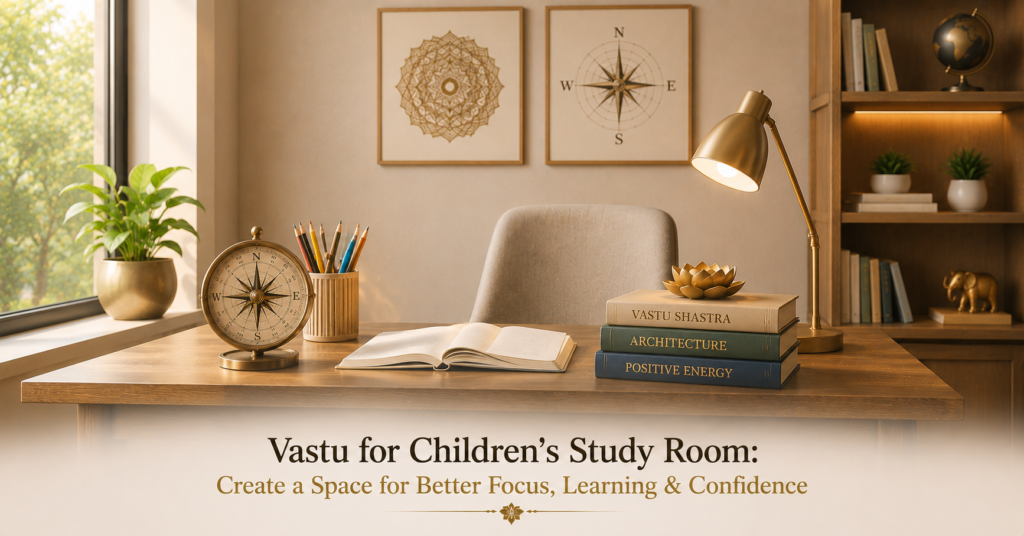
Every parent knows the scene: a child sits down to study, and within minutes the mind wanders, the posture slumps, or the mood dips. Sometimes the cause is the syllabus or the schedule. Sometimes the room itself is working against the child. Light, direction, colour, clutter, and even unseen electromagnetic influences can change how easy it feels to concentrate.
That is where Vastu for a children’s study room becomes genuinely useful. At Samanvay Vastu, we treat the study space as a small system of direction, layout, and energy, and we suggest practical adjustments that fit real homes. This guide covers the best direction and location, desk and seating placement, colours, lighting, common mistakes, and simple corrections, so you can build a room that supports focus, learning, and confidence.
Children are sensitive to their surroundings. A cramped, dark or cluttered corner can make homework feel heavy, while a bright, orderly and calm room invites a child to sit down and begin. Vastu Shastra reads these effects through direction, space and the balance of natural elements, and modern thinking on ergonomics, lighting and distraction control points the same way. Within Residential Vastu, the study room deserves special attention because it is where a child spends long, concentrated hours.
Vastu is not a substitute for good teaching, sleep, nutrition or a steady routine. What it can do is remove avoidable friction from the place where your child studies, so their effort goes further.
Traditionally, the north-east, east, north, and west zones of a home are considered supportive for study. The north-east is linked with clarity and learning, the east with fresh morning energy, and the north with calm concentration. If a dedicated room is not possible, a well-organised corner in one of these zones works well. Avoid placing the study space beside a toilet wall or in a room that doubles as storage.
The most widely recommended direction is east or north-east while studying, with north as a good alternative. Facing east is associated with alertness and memory, and facing north with steady concentration. Try to avoid seating the child towards the south for long hours. In practice, this usually means placing the desk against the west or south-west side of the room.
Choose a square or rectangular desk with clean edges, and avoid irregular or sharply angled shapes. Keep a small gap between the desk and the walls instead of jamming it into a corner. A solid wall behind the child’s back gives a feeling of support, and the child should be able to see the door without sitting directly in line with it.
Pair the desk with a straight-backed chair that lets the child sit upright, which helps both comfort and attention. Keep the desktop tidy, with only current books and stationery on it.
Soft, natural shades work best: light green, pale yellow, cream, off-white and light blue. They reflect light gently, reduce visual strain and keep the atmosphere calm. Very dark tones such as black, deep maroon or heavy grey can make a study room feel confining, while loud, saturated colours may overstimulate. Thoughtful colour balancing does not mean repainting every wall. A single accent wall, curtains or a desk mat can often shift the mood.
Natural light from an east or north window is ideal, so keep windows unblocked and let fresh air circulate. For evening study, use a soft, warm-white lamp placed on the side opposite the writing hand to avoid shadows on the page. Harsh or flickering tube lights tire the eyes quickly and are best avoided.
Place bookshelves along the west or south wall and keep the north-east light and open. Store only what is currently in use, since old papers and broken items weigh on attention. A globe, a motivational picture or an image of Goddess Saraswati in the north-east can serve as gentle inspiration. Avoid violent or gloomy imagery, and keep the wall in front of the desk free of distracting posters.
Screens, gaming consoles, chargers and Wi-Fi routers are part of modern study life, yet they add electromagnetic radiation and constant temptation to the desk area. Where possible, keep the router, television and gaming devices out of the study zone, and keep phones away from the child’s seat during focused study time. If you want to know the actual field levels in the room, a Gauss Meter reading shows how strong the magnetic fields are, so you are not left guessing.
Some rooms feel heavy for no obvious reason. Underground water veins and other geopathic stress patterns are traditionally believed to disturb rest and concentration over long periods. A Lecher Antenna survey, along with an ACMAPOL assessment, helps identify such zones, so the desk and bed are not unknowingly placed over them. This is especially useful when a child’s study or sleep area has stayed in the same spot for years.
If your home cannot follow every guideline, you do not need to rebuild. Rectification without demolition uses shielders, reflectors, pyramids and yantra balancing, along with oils, herbs and colour balancing, to improve a room without breaking a single wall. Often, simply rearranging the desk, shifting a shelf or clearing a corner solves most of the problem.
For families who cannot arrange a site visit, an Online Vastu Consultation lets a consultant review the floor plan and room photographs remotely. Where needed, Personal Energy Balancing looks at the individual alongside the space, so the room-level corrections and the child’s own routine work together.
Start small and observe. Move the desk, clear the clutter, soften the colours and keep electronics out of reach, then notice how your child settles in over a few weeks. A study room should feel comfortable to the child, not merely correct on paper, so adjust when something feels off. Where a problem seems to persist despite a tidy layout, measured readings of the room’s energy conditions give a clearer picture than guesswork.
Which direction should a child face while studying according to Vastu?
East or north-east is preferred, with north as a good alternative. Avoid long study hours facing south.
Can Vastu improve a child’s concentration?
Vastu supports the environment by improving light, order, direction, and calm. It works best alongside a steady routine, adequate sleep and good guidance.
What colours are best for a study room?
Light green, pale yellow, cream, off-white and light blue are good choices. Avoid very dark or harsh shades.
Can a study room be corrected without renovation?
Yes, in many cases. Rearranging furniture and using balancing tools can improve the room without structural changes.
If you are looking for professional Scientific Vastu consultation, energy balancing, geopathic stress analysis, or modern Vastu solutions for your home, office, factory, or commercial space, connect with Samanvay Vastu today.
Skytex Coworks A-64, 3rd Floor, Sector 63, Noida (UP) – 201301
Call: +91 96675 86633
Website: https://www.samanvayvastu.com/
Our expert team provides Scientific Vastu consultation and energy-balancing services across Delhi, Noida, Gurugram, Ghaziabad, Faridabad, Mumbai, Pune, Bengaluru, Hyderabad, and other major cities in India
A child’s study room does not need to be large or elaborate to work well. It needs the right direction, a well-placed desk, gentle colours, good light, and freedom from clutter and distraction. Begin with simple adjustments, keep electronics away from the desk and, where needed, look deeper into the room’s energy conditions. With a supportive space, focus, learning and confidence have a better chance to grow.
A Vastu-friendly children’s study room places the desk in the west or south-west so the child faces east or north, uses light green, cream or pale yellow shades, keeps natural light and ventilation strong, and stays clutter-free. Samanvay Vastu also recommends keeping Wi-Fi routers and electronics away from the desk for better focus.